

Polish roots: the villages your family left
When the great Polish emigration ran, roughly the 1850s to 1914, there was no Poland on the map; there were Polish villages under three empires, and the leaving is remembered in three words: za chlebem, for bread. Around ten million Americans claim Polish ancestry, Chicago long boasted more Poles than any city but Warsaw, and Britain holds a million-strong Polish community across two distinct waves. The villages that were left are in today's Poland (and some beyond its borders), and their year still turns on the odpust and the dozynki.
The Silesians: first to Texas
It began, improbably, in Texas. In 1854 about a hundred and fifty families from villages around Opole in Upper Silesia followed a Franciscan priest to the Texas prairie and founded Panna Maria, the oldest Polish settlement in America, where a Silesian dialect could still be heard a century and a half later. The wider Prussian-partition wave followed to Wisconsin, Michigan and the Chicago mills, from Poznan country and Kashubia (whose largest community abroad gathered around Winona, Minnesota).
Names that came this way: Kowalski, Nowak, Wisniewski, Kaminski, Zielinski, and every -ski a schoolteacher later trimmed.
Galicia and the Russian partition: za chlebem
The flood came after 1890 from the poorest countryside in Europe: Austrian Galicia in the south and the Russian-held villages of central Poland. Whole parishes sent their young to the steel of Pittsburgh, the mills of Buffalo and the stockyards of Chicago, remitting passage money down chains of cousins. One honest note: Galicia straddled today's border, so some ancestral villages now lie in western Ukraine; the records survive, but the map has moved twice since your family walked to the station.
The Poles of Britain: two waves
Britain's Polish story is distinct. The first community was made by war: soldiers of the Polish forces who fought alongside Britain and could not go home after 1945, resettled through camps and hostels into towns across England, Wales and Scotland. The second came after 2004, the largest single migration in modern British history, and made Polish one of the most spoken languages in the UK. For both, the ancestral villages are a short flight away, and the same corridor logic applies as for the Irish in Britain: close enough to actually go.
What is waiting in the village
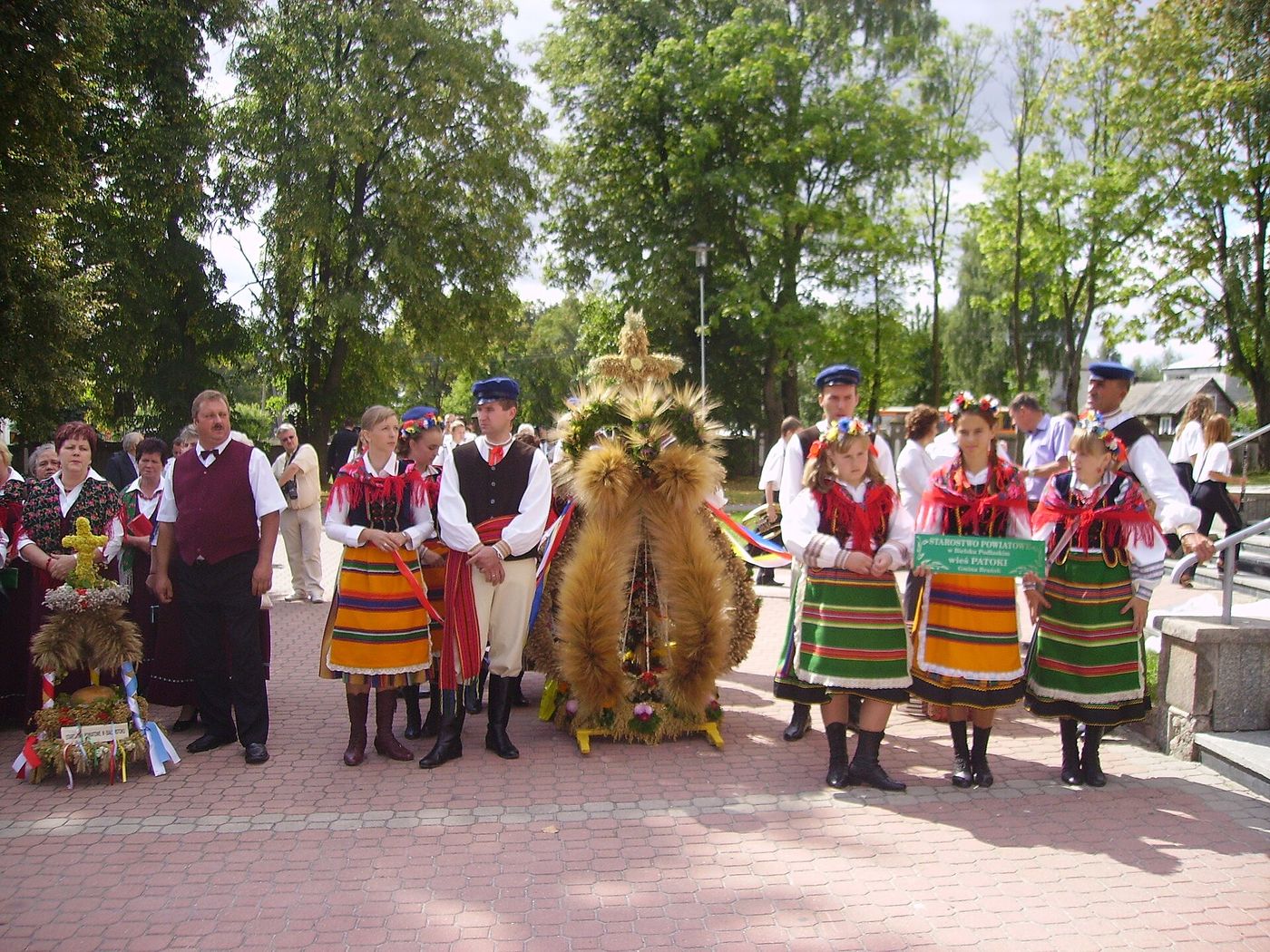
Two institutions above all. The odpust is the parish's patronal feast, part pilgrimage, part fair, stalls and brass and the whole village at church and then decidedly not at church; it is the day the emigrants kept celebrating in Chicago parishes named for the same saints. And the dozynki, the harvest festival, when the village brings wreaths of grain to be blessed and the year's work is danced out; nearly every rural gmina holds one between August and September. Add Corpus Christi processions on flower-strewn streets, the drowning of Marzanna in spring, and the wianki wreaths on midsummer water.
Tracing your actual ancestor
Polish research means knowing which empire kept your family's books: Prussian, Austrian or Russian, each with its own format (and the Russian partition's records in Russian after 1868). The good news is Poland's volunteer indexing is world class: Geneteka has indexed millions of parish entries free, the state archives' search portal serves scans directly, and diocesan archives fill the gaps. Ship manifests and naturalisation papers usually name the village, and for Galician lines the Austrian cadastral maps can show you the very house. Find the parish, and the odpust date follows automatically: it is the patron saint's day.
When Villagly Poland is live, every odpust and dozynki here will link to dates, the organiser's site and places to stay nearby. Stand where your family stood.