









Greek roots: the village your family left
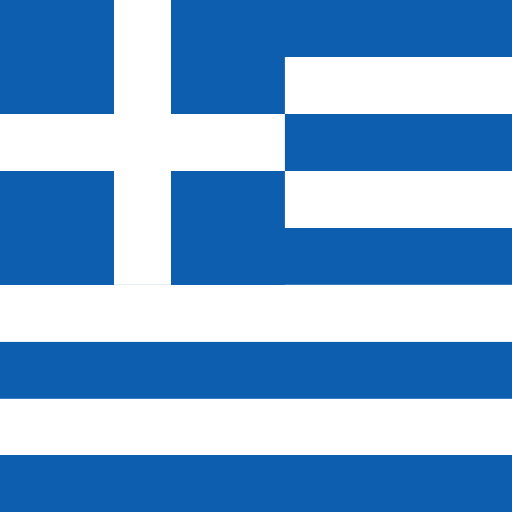
Greeks abroad know their village. Where other diasporas remember a country or a county, a Greek-American or Greek-Australian family can usually name the horio itself, because the emigration worked that way: a village sent its young men to one city abroad, the kafeneio re-formed on a foreign street, and the village association kept the name alive. If your family is part of the Greek diaspora, this is the corridor guide back, and at the end of it is a panigiri, the village saint's-day festival, which has not missed a summer in living memory.
The Peloponnese: to America
The great wave to the United States ran from the 1890s to 1924 and came disproportionately from the hill villages of the Peloponnese, Arcadia and Laconia above all, with Mani sending its famously tough clans. Young men went first to the railroads and mills, then into the diners and candy stores that became a Greek-American institution. Around three million Americans claim Greek descent, and an enormous share of them trace to villages within a day's drive of Tripoli or Sparti, villages whose plane-tree squares still fill for the panigiri every August.
Names that came this way: Pappas, Anagnos, Petrakis, Manos, and every name a clerk shortened from something longer and prouder.
The islands: to Australia
Greek Australia was built island by island: Kastellorizo, the tiny far-eastern island, seeded Perth and Darwin; Ithaca and Kythera sent so many that Melbourne and Sydney cafes were for decades an Ithacan and Kytherian trade; the post-war wave broadened it to all of Greece and made Melbourne one of the great Greek cities of the world. The island villages remember precisely: Kastellorizian, Ithacan and Kytherian associations still run charter-flight pilgrimages home for the panigiri. Our Australian roots guide covers the British half of that country's story.
Asia Minor: the uprooted branch
One branch of many Greek trees does not lead to a village in today's Greece. In 1922 and 1923 more than a million Greeks of Asia Minor were uprooted in the population exchange and resettled across Macedonia, Thrace, Attica and the islands, often founding new villages named for the lost ones, Nea Smyrni, Nea Fokaia and dozens more. For those families the ancestral village is in Turkey, but the living community, its music and its festivals are in the Nea villages, which hold their own panigiria and memory days.
What is waiting in the village: the panigiri
The panigiri is the Greek village at full strength: the saint's vespers, then long tables in the square, lamb and wine, the clarino striking up and circle dances until dawn, everyone from the village and everyone whose grandparents left it. August is the high season, around the Dormition on the fifteenth, when the diaspora flies home and half-empty villages triple overnight. Add the wine and chestnut festivals of autumn, the olive harvest, and Easter, which no Greek village does small, and the calendar back is always open.
Tracing your actual ancestor
Greek records are village records. Every municipality keeps the dimotologio, the citizen rolls organised by family, and the mitroon arrenon, the register of males kept since the nineteenth century for conscription, both reachable through the local dimos once you know the village. The General State Archives hold older registers, and on the arrival side Ellis Island manifests usually name the village outright. Greek naming customs help too: the first son takes the paternal grandfather's name, so given names cycle in a traceable rhythm. Once you have the horio, go in August.
Villagly Greece links every panigiri here to dates, the organiser's site and places to stay nearby. Stand where your family stood.