





French roots: the villages your family left
France sent fewer emigrants than its neighbours, which makes the French corridors unusually traceable: a small number of villages, documented to the parish register, produced enormous descendant populations. Around ten thousand settlers who crossed to New France in the seventeenth century became millions of French Canadians and Franco-Americans; a few Atlantic-coast villages became Acadia, and Acadia became Cajun Louisiana. If your name is Tremblay, Gagnon, Roy, Boudreaux or Hebert, the village your line left is not a guess. It is on record, and it still holds its fete every summer.
New France: Normandy, Perche and Poitou to Quebec
The founding families of Quebec came overwhelmingly from the north-west: Normandy, the little county of Perche, Poitou, Aunis and Saintonge, shipping out through La Rochelle and Dieppe. Because the population was small and the church kept meticulous registers on both sides of the Atlantic, French Canada is one of the best-documented ancestries on earth; most Quebecois can reach their exact home parish in a few evenings. The Perche villages that sent the Tremblays and Gagnons are still farming villages, comices agricoles, apple fairs and all.
Names that came this way: Tremblay, Gagnon, Roy, Cote, Bouchard, Gauthier, Morin, and nearly every name in the Quebec phone book.
Acadia to Louisiana: the Cajun corridor
The Acadians came mostly from the marshland villages of Poitou and the countryside around Loudun, settled the Bay of Fundy, and were expelled by the British in 1755, the Grand Derangement. Thousands eventually re-gathered in Louisiana, where Acadian became Cadien became Cajun. A Louisiana Boudreaux, Thibodeaux or Broussard is carrying a village name from the French Atlantic coast through a three-hundred-year detour, and the fais-dodo of a Cajun Saturday night is a French village dance that survived two continents.
The Basques and Bearnais: to the Americas
Through the nineteenth century the mountain villages of the French Basque country and Bearn sent younger sons in their tens of thousands to Argentina, Uruguay, Chile and the American West, where Basque shepherds worked the ranges of Idaho, Nevada and California. Whole valleys emptied towards Buenos Aires; there are more descendants of Basques in the Americas than Basques in Europe. Our Argentine roots guide tells the destination side of that story.
The Huguenots: the scattering
Two centuries earlier, Protestant France scattered: perhaps two hundred thousand Huguenots left after 1685 for England, Ireland, the Netherlands, Prussia, the Cape of Good Hope and the American colonies. Weaver surnames in Spitalfields, wine names at Franschhoek in South Africa and Bosman and du Plessis on a South African tree all trace to French villages, many in the Cevennes and the south-west. Our South African roots guide picks up the Cape thread.
What is waiting in the village
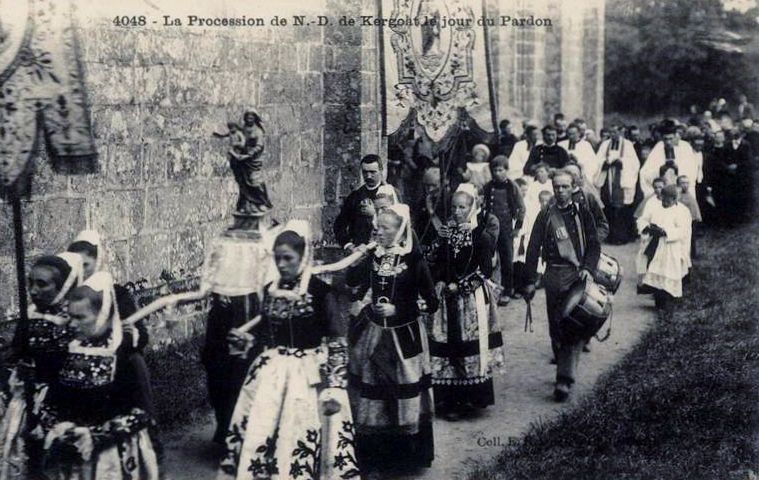
Rural France runs on the fete votive, the village's own festival on its patron saint's weekend: three days of long tables, boules, brass bands and dancing that even the smallest place still keeps. Brittany adds the pardon, procession and pilgrimage in one; wine villages add the fete des vendanges at harvest; mountain villages mark the transhumance, driving the flocks up and down with flowers and fanfare. The village your family left is very likely holding its fete this summer on the same saint's day it kept when they boarded the ship.
Tracing your actual ancestor
For Quebec lines, the parish registers were duplicated and indexed almost completely; the PRDH database at the University of Montreal reconstructs every family of the French regime, and the free Fichier Origine names the French home parish of thousands of founding settlers. French records themselves are held by departmental archives, nearly all free online: parish registers to 1792, civil registration after. For Acadian lines, the Grand Derangement scattered the paperwork but a large genealogical literature has reassembled it. Find the parish, and you have found the village and its fete.
When Villagly France is live, every fete here will link to dates, the organiser's site and places to stay nearby. Stand where your family stood.