





























American roots: the villages your family left
No country received more people from Britain and Ireland than the United States. They went in waves, each one from a different kind of place: Ulster farm country, Cornish mining villages, Welsh coalfield chapels, Irish parishes emptied by famine, West Country market towns. If your family story starts with an Atlantic crossing, the place it really starts is a village, and the village is still there.
The Ulster-Scots: to Appalachia
Through the eighteenth century, some quarter of a million people left Ulster for the American colonies, and their descendants became the backbone of Appalachia and the American South. The fiddle tunes of the mountains are the reels and airs of Antrim and Donegal, carried in memory. In America the name stuck as Scotch-Irish; the townlands they left are in today's Northern Ireland and across the border into Donegal.
Names that came this way: Jackson, Houston, Calhoun, McCrea, Armstrong, and half the surnames of country music.
The Irish: the famine ships
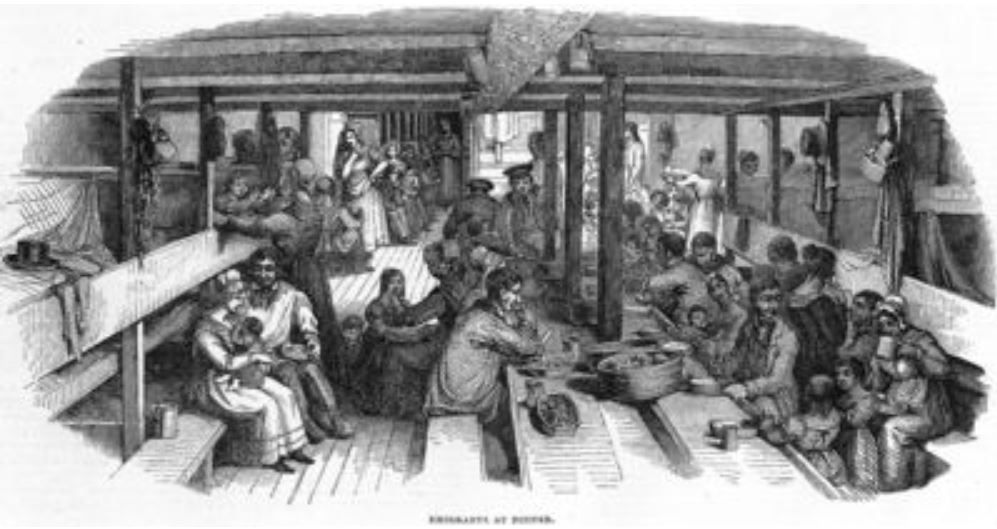
In the decade after 1845 well over a million people left Ireland, most of them for America, and rural parishes from Cork to Mayo sent whole generations to Boston, New York and beyond. Irish surnames still carry their counties: Ryan of Tipperary, O'Brien of Clare, Kelly of Galway, Murphy of Cork and Wexford. Villagly Ireland now covers village events across all 26 counties; find the county your family left and see what is on.
The Cornish: to the Copper Country
Wherever America sank a shaft, a Cornishman was at the bottom of it: the copper of Michigan's Keweenaw, the silver of Nevada's Comstock, the gold of Grass Valley, California, and the copper of Butte, Montana, where the pasty is still local food. They came from the mining villages around Redruth, Camborne and the tin coast. Read the full Cousin Jacks story →
The Welsh: coalfields and choirs
Welsh miners and their chapels built Scranton and Wilkes-Barre in Pennsylvania, and Welsh Mormon converts crossed to Utah in their thousands, where their singing tradition fed into the great Salt Lake City choirs. Jones, Williams, Evans, Davies and Hughes on an American tree point back to Wales.
Tracing your actual ancestor
The Statue of Liberty and Ellis Island Foundation's free passenger database covers arrivals from 1820 to 1957, and the US National Archives holds the originals. From the British end, outward passenger lists from 1890 are at The National Archives at Kew and digitised on the main genealogy sites; from 1922 they record a home address, which can point you back to the very village. Parish registers then take the trail back centuries.
Every event above links to dates, the organiser's site and places to stay nearby. Stand where your family stood.